
What to See Inside Hagia Sophia: 12 Unmissable Details and Their History

Updated: Dec 8, 2025

When Dharma and I stepped into Hagia Sophia, we had no idea we were about to gain an unofficial (yet somehow very official) tour guide. The fee to enter the Hagia Sophia is about $30 each and, after picking up our tickets at the Hagia Sophia Museum across the Hippodrome square, we passed through the gatekeepers and metal detectors and made our way up the stone, tunnel-like ramps that lead to the second floor of the mosque. (The mosque is currently undergoing renovations and is full of scaffolding inside and out. Still stunning though!)

I had visited Hagia Sophia a couple of times before, when the first floor was open to tourists and entry was completely free. (Possibly the same reason Pope Leo, who recently visited Istanbul, chose not to visit the mosque this time? There’s been a lot of conversation about whether a house of God should require an admission fee. I wonder...)
Once Dharma and I reached the upper level, we came across three mosque attendants. I struck up a conversation with them, starting with the question, “Why can’t tourists visit the first floor anymore?” We joked around a bit, and Dharma (who is surprisingly personable for someone who identifies as an introvert) formed an instant connection with one of the guards, a man named Ümit. Within minutes, Ümit graciously took it upon himself to walk us around the entire second floor and essentially become our personal guide.
Here are the main attractions to not miss, according to Ümit (and the plaques next to each spot).
Mosaic of Emperor Alexander (10th Century)


This mosaic depicts Emperor Alexander, the brother and very short-term successor of Leo VI, who ruled the Byzantine Empire for barely a year (912–913). Alexander was famously eccentric (read: wild), the kind of ruler who kept everyone guessing and the Church collectively sweating.
Despite not being their favorite emperor, he made a generous donation to Hagia Sophia, which meant the clergy had to immortalize him in mosaic form whether they liked it or not. Their solution? Tuck him away in a dark little corner of the upper gallery, where he technically gets his honor… but absolutely not a spotlight. Even today, it’s one of the most deliberately low-key imperial mosaics in the entire building.
The Empty Tomb of Enrico Dandolo
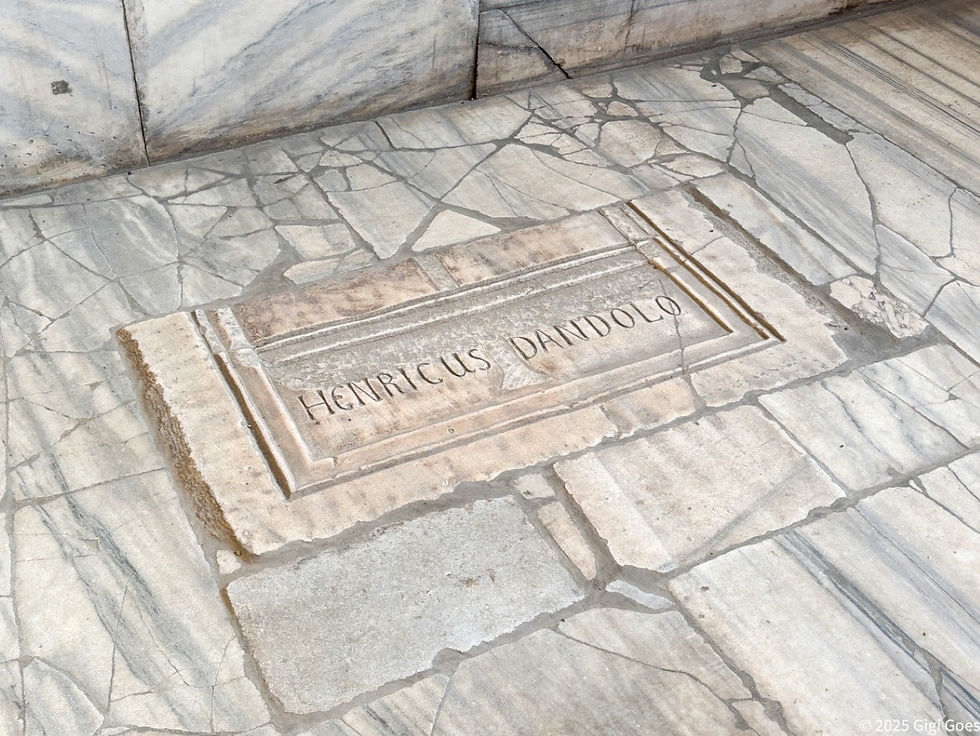

This stone slab marks the former burial spot of Enrico Dandolo, the blind-but-still-chaotic Doge of Venice who masterminded the Fourth Crusade and its disastrous detour into sacking Constantinople in 1204. After crowning themselves the new rulers of the city, the Latin Crusaders converted Hagia Sophia into a Roman Catholic cathedral, and since Dandolo was their hero (if no one else’s), they honored him with a burial inside the most important sacred building in the empire.
His actual remains vanished after the Byzantines retook the city (or possibly after the Ottomans’ 1453 conquest) leaving only a later 19th-century cenotaph to mark where he “probably” was. For decades, everyone assumed his bones were long gone… until a 2021 TRT documentary used georadar to detect a human skeleton sitting just beneath the memorial stone, facing Jerusalem. Height, posture, burial style- everything oddly lines up with Dandolo himself. So his final resting place might actually still be in the famous mosque.
(Fun fact: According to Ümit, they still have visitors, clearly unapproving of the crusaders sacking Constantinople, that spit on Dandolo's grave as they pass by.)
The Empress Zoë Mosaic (11th Century)

Rediscovered in 1934, the Empress Zoë mosaic is basically her relationship history told in shimmering tesserae. Zoë, daughter of Constantin
..e VIII, married late in life to Romanos III at her father's behest, then promptly fell for a younger stable boy named Michael. Romanos soon suspiciously drowned in the bath (as one does) and Zoë and Michael wed the same day, with Michael becoming Emperor from his new marriage. (Nice pay raise!)
After Michael IV died, his nephew Michael V tried to sideline Zoë by imprisoning her, which sparked a public revolt. He was overthrown, and Zoë’s third husband, Constantine IX, took the throne.
With every marital upgrade, the mosaic artists simply swapped out the emperor’s face, a medieval version of photoshopping your new guy's face over your ex's. Even Zoë’s own face (and Christ’s!) isn’t original, possibly redone for stylistic consistency or because the mosaic was simply exhausted by her plot twists.
The Apse Mosaic of the Virgin and Child

High above the nave sits the Apse Mosaic of the Virgin and Child, created around 867 CE... and it’s far more than a pretty shimmer of gold. This was the first major mosaic installed after the end of Byzantine Iconoclasm, the empire’s century-long phase of “no pictures allowed.” When icons were finally restored, the Church made its comeback statement in the boldest place possible: Hagia Sophia’s central apse.
Here, Mary sits regally on a jeweled throne, holding the Christ Child on her lap, radiating serenity and authority in equal measure. It was meant to announce, loud and clear, that sacred images were officially back and here to stay.
Today, parts of the mosaic are partially hidden by structural coverings and restoration elements, which somehow adds to its mystique, like a VIP artwork glimpsed behind the velvet rope.
(The sheets are there to protect the mosaics as the mosque is undergoing construction.)
Viking Runic Graffiti (“Halfdan Was Here”)

These markings are Norse runes carved into the marble by a Varangian Guard, elite Viking warriors who served as bodyguards to Byzantine emperors. (Actual vikings at the Hagia Sophia! How neat!) The most famous inscription reads “Halfdan was here,” making this one of the oldest pieces of “tourist graffiti” in the world. It’s a tangible reminder of how far Hagia Sophia’s influence reached.
(Halfdan's inscription is covered by plexiglass, so Dharma helped me out with the glare.)
The Southern Vestibule Mosaic (A Byzantine Thank-You Card in Gold)


In this mosaic, the Virgin Mary sits serenely with the Christ Child while two of Byzantium’s VIP emperors line up to make their offerings. On the left, Constantine the Great presents the entire city of Constantinople. On the right, Justinian I offers Hagia Sophia itself, the architectural masterpiece he built. It’s basically a glittering imperial thank-you card, immortalized in gold, showing the two men who gave Byzantium its greatest city and its greatest church… both respectfully handing everything over to Mary and Jesus. (And check out that ceiling!)
The Deësis Mosaic (13th Century): Byzantium’s Most Emotional Portrait


This fragment of the Deësis Mosaic is one of Hagia Sophia’s greatest artistic treasures, created around 1261 to mark the end of Latin rule and the restoration of the Byzantine Empire. At the center, Christ Pantokrator looks out with striking realism, holding the Gospel and raising His hand in blessing. To His left is the Virgin Mary; to His right, John the Baptist, both shown leaning toward Christ in a pose of deep appeal.
This scene represents the Deësis, a traditional Byzantine theme where Mary and John act as intercessors for humanity, pleading on our behalf. Even with large sections missing, the surviving faces and folds of the garments show some of the finest mosaic craftsmanship of the Middle Ages. The emotional intensity in their expressions is a dramatic shift from earlier, more formal iconography, a reminder that this was Byzantium’s artistic comeback after decades of turmoil.
The way the artists used mosaic to create light and shadow is truly amazing. It is absolutely breathtaking in person.
The Marble Doorway (The “Door of Heaven and Hell”)

Located near the Empress Lodge, this intricately carved marble doorway, known as the Door of Heaven and Hell, once separated Hagia Sophia’s west and south galleries. Its panels include subtle carvings of fruit and fish, symbols often tied to abundance and early Christian imagery.
Behind this doorway lay a private chamber used by clergy for important religious meetings. In 1166, it even hosted the Synod Council, whose decisions were so significant they were later inscribed on marble tablets and displayed in the outer narthex.
Today, the doorway stands as a beautifully preserved reminder that Hagia Sophia’s upper levels weren’t just architectural showpieces, they were the backstage rooms where real Byzantine power plays unfolded.
The Ceilings of Hagia Sophia
Look up inside Hagia Sophia and you’ll find some of the most spectacular ceilings in the world, a swirling mix of Byzantine geometry, color, and centuries of history layered right over one another. The golden backgrounds and star-studded bands date back to the 6th century, originally meant to mimic the shimmering heavens. Many of these patterns were restored during the Ottoman era, which is why you’ll see a blend of Byzantine motifs and later Islamic artistry sharing the same arches.
Some sections are worn or patched, others still glow with their original brilliance, and a few areas reveal older mosaic layers peeking out from behind newer plaster. Standing beneath these ceilings feels a bit like being inside a kaleidoscope designed by a perfectionist empire: every arch is intentional, every medallion meaningful, and every flake of peeling paint a reminder that this place has survived 1,500 years of earthquakes, conquests, and endless admiration.
The Marble Floors: A 1,500-Year-Old Patchwork Masterpiece

Hagia Sophia’s marble floors are one of its most underrated wonders. Laid in the 6th century, the slabs come from quarries across the Byzantine world: green Thessalian marble, purple porphyry from Egypt, white Proconnesian stone from the Sea of Marmara, and more. Justinian’s architects arranged them in deliberate patterns so that the natural veining created mirrored, almost psychedelic designs.
The decorative strip you see here is opus sectile, an ancient technique where colored marbles are cut and fitted together like a stone mosaic. It was used to mark pathways, frame important areas, or simply add a touch of imperial flair, because why have a plain walkway when you can have a geological runway?
The Empress Lodge: Byzantium’s Best Seat in the House


This elevated section of the upper gallery is known as the Empress Lodge, the spot where the Byzantine empress and her ladies watched the liturgy from above the nave. In a church designed to make emperors feel like God’s chosen rulers, the empress got a viewing box to match — private, elevated, and with a perfect line of sight to the altar below.
The lodge is distinguished by its green Thessalian marble columns, ornate capitals, and the carved marble railing that separated the imperial women from the crowds. From here, the empress could participate in ceremony without having to push through the masses, be jostled by clergy, or risk someone stepping on the hem of her very expensive robes.
Today, visitors can stand in the same space where royalty once observed the grand pageantry of the Byzantine liturgy, minus the velvet cushions, gold embroidery, and imperial security detail. But the view? Still absolutely worthy of an empress.
A Peek at the Baptistery Courtyard

On your way out of Hagia Sophia’s upper gallery, you’ll catch this quiet little view through an old arched window: a glimpse into the baptistery courtyard, one of the building’s oldest and most atmospheric corners. Below sits the stone baptismal pool (vaguely hidden on the right), once used for full-immersion baptisms during the Byzantine era. The large jars and architectural fragments scattered around the courtyard hint at centuries of reuse, repairs, and reshuffling.
It’s a surprisingly peaceful scene tucked behind one of the busiest monuments on earth and a reminder that Hagia Sophia wasn’t just an imperial showpiece, but a working church where real spiritual milestones unfolded.


Comments