
The Basilica Cistern: Istanbul’s Hidden World Below

Exploring Istanbul’s most atmospheric underground space

You know that feeling when a city suddenly gets quiet and you realize you have stepped into a completely different world?
That is the Basilica Cistern.
One minute you are walking past street vendors and honking cars near Hagia Sophia. The next, you are entering a totally nondescript building and descending underground into cool air, dripping water, glowing arches, and a place that feels like a cinematic dream sequence.
If Istanbul has secrets, this is where it keeps them.
First Impressions: Cool, Dark, and Instantly Cinematic

The moment you step inside, everything slows down.
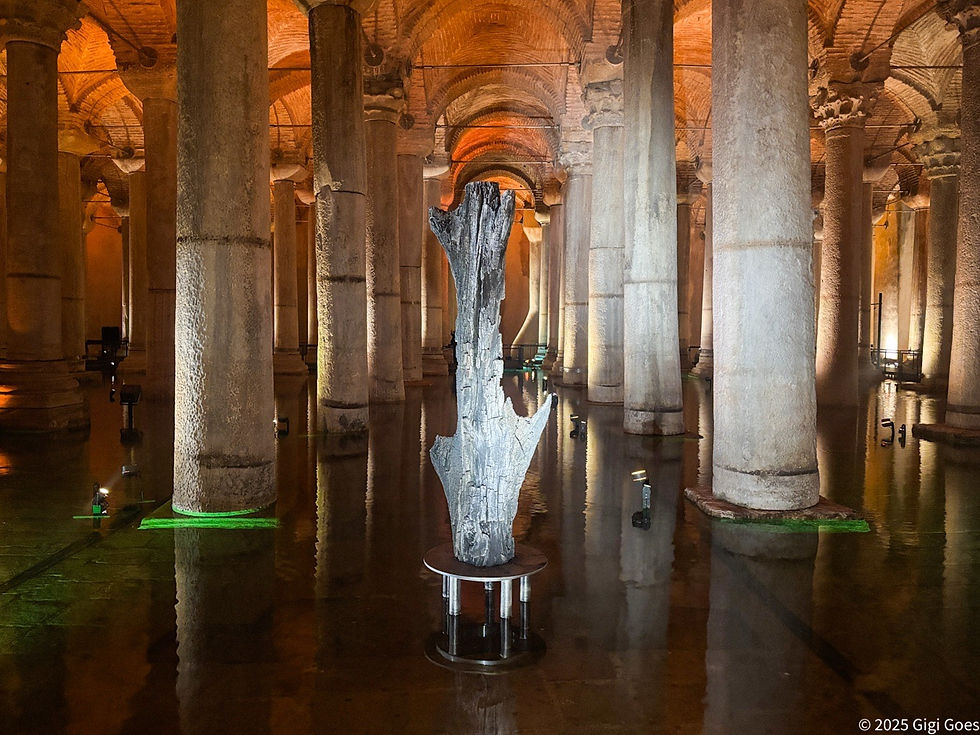
The lighting is low and dramatic. The air is cool. The floor glistens with shallow water that reflects endless rows of stone columns stretching into the distance. Every sound echoes softly. Footsteps. Water droplets hit your head every now and then. Visitors naturally lower their voices.
It feels less like a tourist attraction and more like you accidentally wandered onto the set of a fantasy movie.
Or an underground dragon lair.
What Is the Basilica Cistern, Really?

The Basilica Cistern is not just a unique underground space. It was a serious piece of infrastructure, and a quietly brilliant one.
Built in the 6th century during the reign of Byzantine Emperor Justinian I, the cistern was designed to solve a very practical problem. Constantinople needed a reliable water supply that would not fail during sieges, droughts, or political chaos. The answer was to hide the water underground, safe, cool, and out of sight.
Water was brought in from forests north of the city through a vast network of aqueducts, including the still-standing Valens Aqueduct. From there, it flowed into this enormous underground reservoir, which could hold tens of thousands of tons of water. This water supplied the Great Palace and important public buildings nearby.
Even the name “Basilica Cistern” is a bit misleading. There was once a basilica (a large public building) above it, which is how the cistern got its name, but the space itself was never meant to be seen. It was designed to disappear beneath the city, doing its job silently for centuries.
After the Ottoman conquest of Constantinople, the cistern fell into relative obscurity. Locals knew it was there, and some reportedly drew water or even fish from holes in their basements, but the cistern itself was largely forgotten by the outside world.
It was rediscovered by a Western traveler in the 16th century, who described the locals pulling fish up from below their homes. Eventually, the cistern was cleaned, restored, and opened to visitors.
Today, it no longer supplies water to the city, but it does something else entirely: it reminds you that Istanbul has always been a place that thinks ahead, builds big, and hides its brilliance in unexpected places.
What else might lie beneath?
The Columns: Endless, Uneven, and Full of Personality
What makes the Basilica Cistern especially fascinating is how it was built.
The 336 columns supporting the ceiling were not carved specifically for this space. Many were repurposed from earlier Roman buildings, temples, and structures around the empire. That is why the columns vary in style, height, and decoration. Some are plain. Others are ornate. Some look slightly mismatched. Some are smooth. Some are rough. Some have intricate carvings.
It is architectural recycling on an imperial scale.
The Medusa Heads: Sideways, Upside Down, and Completely Unbothered


Yes, the Medusa heads are real. And yes, they are as strange as everyone says.
Two massive stone heads of Medusa sit at the base of columns in a far corner of the cistern. One is sideways. The other is upside down. No official explanation. Plenty of theories.
Was it to neutralize her powers? Was it structural convenience? Was it a quiet act of rebellion? Nobody knows for sure.
What we do know is that Medusa has been down there for centuries, watching visitors bend, crouch, and twist themselves into awkward positions just to get the photo.
When Ancient Meets Modern

One of the most surprising parts of the Basilica Cistern is how modern elements have been woven into the space.
Soft colored lights glow beneath the water. Art installations rise from the shallow pools. Sculptural pieces cast eerie shadows onto brick walls that have stood for over a thousand years.
Instead of feeling out of place, it works.
The old stone does not fight the modern art. It absorbs it. The result is something that feels timeless rather than preserved.
The Ceiling: Do Not Forget to Look Up


It is easy to get distracted by reflections and columns, but look up.
The brick vaults above form repeating arches that stretch endlessly overhead. The texture of the bricks, the symmetry, and the warm lighting create patterns that are almost hypnotic.
At certain angles, the ceiling feels just as dramatic as the water below it.
This is a place that rewards wandering slowly and looking everywhere.
How It Feels to Walk Through It

Quiet. Grounding. Meditative.
People naturally lower their voices. Nobody rushes. You walk along raised platforms just above the water, pausing often because something catches your eye every few steps.
It feels contemplative without being heavy. Mysterious without being scary. Calm without being boring.
If Istanbul above ground is alive and loud, the cistern is its deep breath.
Basilica Cistern Istanbul: Tips For Visiting
Wear shoes with decent grip. The walkways will be damp.
Go earlier in the day or later in the evening for fewer crowds.
Take your time. This is not a quick stop.
Photos look incredible in low light, but steady hands help.
Expect it to be cooler than outside, even in summer.
Final Thoughts: One of Istanbul’s Best Layers
Istanbul is a city built in layers. Roman. Byzantine. Ottoman. Modern.
The Basilica Cistern is one of the rare places where you can physically step beneath the city and feel those layers pressing in around you.
It is beautiful. It is strange. It is unforgettable.
If you only have a couple of hours in Istanbul and can only choose one place to visit, this is it.


Comments